
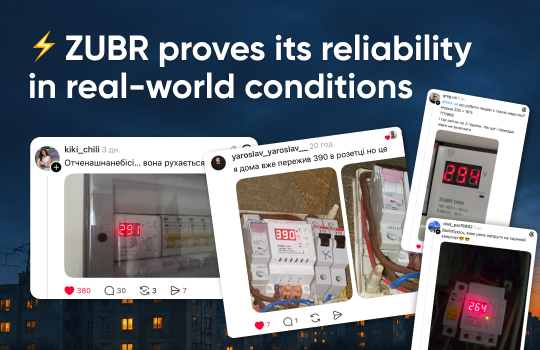
160 V, 270 V, 300 V, and even higher — these are the voltage levels Ukrainians have recently been reporting on social media. Sometimes, power is restored for just a few hours, but people still cannot use their electrical appliances. The voltage monitoring relay cuts off the power supply to protect household appliances from dangerous voltage fluctuations.
Over the past few days, we have been actively communicating with users on Threads, answering questions about unstable mains voltage and helping them understand how to set up their ZUBR voltage monitoring relays.
We have noticed that many questions come up again and again: «What voltage limits should I set? Can I lower the minimum limit to 170 V? How can I set the restart delay so the relay does not switch on and off every minute? And is a voltage stabilizer really better than a relay?»
We have collected the most common questions and our experts’ recommendations in one article.
Key points at a glance:
- The factory voltage limits for ZUBR voltage relays are 198–253 V. We recommend keeping these settings.
- For refrigerators, air conditioners, and other appliances with compressors, we recommend setting a restart delay of 120–180 seconds.
- We do not recommend lowering the minimum voltage limit to 170–180 V without checking the specifications of your connected appliances.
- A voltage relay protects electrical appliances from dangerous voltage fluctuations, but it does not stabilize the voltage.
- If the voltage regularly goes beyond the safe limits, you need to find out why this is happening instead of simply widening the protection limits.
1. Why does the ZUBR voltage monitoring relay cut off the power even when electricity is available?
The ZUBR voltage relay works as a voltage cut-off device. It constantly monitors the mains voltage and automatically disconnects the power supply if the voltage goes above or below the set limits. Once the voltage returns to the acceptable range, the relay restores the power supply after the set delay.
For example, if the voltage in your home drops to 160 V or rises to 280 V, the relay will disconnect your appliances to help prevent possible damage.
So, if your neighbours have electricity but you do not, it does not necessarily mean that your voltage relay is faulty. Most likely, it is simply doing its job.
Important: a voltage monitoring relay does not stabilize the voltage or keep it at a constant level. Its job is to monitor the mains voltage and disconnect the power supply when the voltage reaches dangerous levels.
2. What minimum and maximum voltage limits do we recommend?
Since July 1, 2025, the nominal voltage in Ukraine’s power grids has been 230 V instead of the previous 220 V. According to the EN 50160 standard, the normal voltage variation range is ±10 %, which means 207–253 V.
ZUBR voltage relays have the following factory settings:
- 198 V — minimum voltage limit;
- 253 V — maximum voltage limit.
We kept the minimum limit at 198 V from the time when the nominal mains voltage was 220 V. As the manufacturer, we recommend keeping the factory settings of ZUBR voltage relays. They provide a reasonable balance between protecting household appliances and making everyday electricity use more convenient.
However, the power supply situation in many parts of Ukraine is extremely difficult right now. Frequent voltage fluctuations sometimes force users to look for a compromise.
In extreme cases, you may consider widening the voltage limits to 185–260 V, but this is at your own risk and only if all connected appliances are rated to operate within this range according to their manufacturers’ specifications. We do not recommend setting these values just to make the relay trip less often.
Please note: the 207–253 V range in the standard describes power quality requirements and measurement conditions. This does not mean that every short-term deviation beyond these limits automatically indicates a violation of the standard.
3. Can I set the minimum voltage limit to 170–180 V?
This is one of the most common questions we receive on Threads. Some users say their household appliances continue to work at 170 V, so they do not see the point of setting a higher cut-off limit. But there is an important detail: the fact that an appliance still works at low voltage does not mean it is safe to operate under these conditions.
Appliances with electric motors and compressors can be especially sensitive to low voltage:
- refrigerators and freezers;
- washing machines;
- air conditioners;
- pumps and other pumping equipment.
When the voltage is too low, an electric motor may fail to start properly, overheat, or operate under excessive strain. This can lead to faster wear and tear. At the same time, some modern electronic devices have a wide input voltage range, such as 100–240 V. That is why you should always check the specifications of each appliance rather than simply relying on whether it continues to work.
Our recommendation: do not lower the minimum voltage cut-off limit without a good reason. If you decide to change the settings, first check the acceptable voltage range of all connected appliances.
4. The ZUBR voltage monitoring relay keeps clicking and switching the lights on and off. What should I do?
On Threads, some users even compare this situation to a 1990s disco light show. This usually happens when the mains voltage keeps fluctuating around the relay’s set cut-off limits. For example, the voltage rises to 255 V, so the relay disconnects the power supply. After some time, the voltage drops back to an acceptable level, and the relay restores the power. Then the same thing happens again.
To reduce how often the relay switches on and off, we recommend checking the restart delay setting — ton (Time On).
For household appliances, especially refrigerators and air conditioners, we recommend setting the delay to 120–180 seconds. This means that after the voltage returns to the acceptable range, the relay will not restore the power supply immediately. Instead, it will wait for the set time to pass. This setting helps prevent frequent restarts of appliances with compressors when the power supply is unstable.
Please note: The restart delay does not eliminate voltage fluctuations or prevent further cut-offs if the voltage goes beyond the set limits again.
5. How do I change the ton restart delay on a ZUBR voltage monitoring relay?
On most modern ZUBR models, you can change this setting directly in the device menu. Follow these steps:
- Press the menu button “≡”.
- Find the ton (Time On) setting.
- Use the “+” and “−” buttons to set the required value, for example, 120 or 180 seconds.
- Wait until the device returns to displaying the voltage. The settings will be saved automatically.
The menu layout and available settings may vary depending on the relay model and its production year. For more information about the settings of specific models, please see the manuals:
6. The ZUBR voltage monitoring relay has locked for an hour. how can I restore the power?
Some ZUBR models have a feature called REP — protection against frequent repeated trips. It is designed for situations when the mains voltage is so unstable that the device repeatedly disconnects and restores the power supply.
This is especially useful when nobody is home and household appliances could keep switching on and off.
In newer firmware versions, the REP protection automatically resets after one hour. But what if electricity is available according to the schedule for only two hours?
If you are at home, you do not have to wait for the full hour. On models that support this feature, you can press any button on the voltage relay to unlock it manually. The power supply will be restored if the voltage is within the acceptable range.
You can also adjust the number of repeated trips that activate REP or disable this feature. However, we do not recommend disabling additional protection without a good reason.
Please note: the way REP works depends on the voltage relay model and firmware version. Before changing these settings, we recommend checking the user manual for your specific device.
7. What Is the difference between a voltage monitoring relay and a voltage stabilizer?
Another common question is: if the voltage relay keeps disconnecting the power, would it be better to install a voltage stabilizer? These are two different devices with different purposes.
A voltage relay monitors the mains voltage and disconnects the power supply when the voltage goes beyond the set limits.
A voltage stabilizer adjusts the incoming voltage and maintains a more stable output voltage within its operating range.
If the voltage in your power grid is constantly too low or too high, a stabilizer may indeed be a better solution. However, stabilizers are usually more expensive, larger in size, and their performance is also limited by the acceptable input voltage range and rated power. That is why, for many apartments and houses where the voltage is usually normal but dangerous fluctuations occur from time to time, a voltage relay remains a practical way to protect household appliances.
8. Do I need a separate voltage monitoring relay for every appliance?
No, not necessarily.
For a single-phase power supply, one properly selected voltage relay installed in the electrical panel is usually enough to protect all the appliances in an apartment.
For a private house with a three-phase power supply, you can use three single-phase voltage relays — one for each phase — or another suitable three-phase protection solution, depending on the electrical system.
There are also plug-in ZUBR models that do not require installation in the electrical panel. For example, ZUBR R1 can be used to protect individual appliances. The main thing is not to exceed the maximum load specified in the device’s technical specifications. This is a convenient option, especially for rented homes where you cannot make changes to the electrical panel.
Learn more about the ZUBR R1 plug-in voltage monitoring relay
9. Can I install a voltage monitoring relay in the electrical panel myself?
Our device manuals state that installation must be carried out by a qualified electrician. We understand that electricians are in high demand right now, and finding an available specialist can be difficult. However, correct wiring, choosing the right rated current, and making secure electrical connections are essential for safe and reliable operation.
When choosing a voltage relay, it is important to consider its rated current, the characteristics of the main circuit breaker, the mains voltage, and the wiring diagram. That is why we recommend having a qualified electrician select and install your voltage relay.
10. Why do ZUBR voltage monitoring relay readings differ from those of another voltmeter?
Sometimes users notice that the voltage shown on their ZUBR relay is different from the reading on another measuring device. One possible reason is that the devices use different measurement methods.
Modern ZUBR models equipped with True RMS technology measure the actual RMS voltage value. This allows them to provide more accurate readings, including when the voltage waveform is distorted. So, the first thing to check is whether your reference voltmeter also supports True RMS.
Some ZUBR models also have a Cor (Correction) setting that allows you to adjust the displayed voltage reading. Check whether its value has been changed accidentally.
What Should You Do If the Mains Voltage Regularly Goes Beyond the Acceptable Limits?
A voltage relay helps protect your electrical appliances, but it cannot fix the cause of unstable voltage.
If you regularly see readings of 170 V, 270 V, or even more extreme values, you should contact your local electricity distribution system operator and report the problem.
It is also a good idea to ask a qualified electrician to check the electrical wiring in your house or apartment. Voltage fluctuations can be caused not only by problems in the external power grid but also by faulty wiring or loose electrical connections.
Do not try to deal with critically unstable voltage simply by widening the relay’s cut-off limits.
The Main Things to Remember
We understand how difficult it is to live without electricity, especially when power is available for only a few hours a day. And when the electricity finally comes back but the voltage relay does not allow you to use it, this can understandably be frustrating.
However, it is important to remember: the voltage relay does not disconnect the power to make your life more difficult. It does so to protect your appliances from possible damage.
Here are our main recommendations:
- Keep the factory voltage limits of ZUBR — 198–253 V.
- Set a restart delay of 120–180 seconds for appliances with compressors.
- Do not widen the voltage limits without checking the acceptable voltage range of your connected appliances.
- If the relay trips frequently, find out why the mains voltage is unstable instead of simply disabling the protection.
- Have a qualified electrician select and install your voltage relay.
We will continue to follow users’ questions on social media and help them understand how to set up and use our devices.
If you still have questions about your ZUBR voltage relay, contact our technical support team via the Telegram bot @dselectronics_bot. Take care of yourself and your appliances! 💙
Comments